Stop the Spread of GSOB: Don’t Move Oak Logs
By Ruth Wallen
[Ruth Wallen is an artist and writer whose work is dedicated to encouraging dialogue around ecological and social justice. Her photomontages, interactive installations, nature walks, web sites, artist books, performative lectures, and essays have been widely published and exhibited. Committed to student-centered learning, she served as chair and faculty for the MFA in Interdisciplinary Arts Program at Goddard College for many years as well as a lecturer at UCSD. Her recent work bears witness with trees dying from urbanization, globalization, and climate change, synthesizing her insights from artistic and scientific training. See www.ruthwallen.net for more information.]
As I walk the two steps up to the suspension bridge, I enter another world. Light fades. Fields of dry white buckwheat flowers give way to tangled branches, tangled roots, and a ceiling of green. A pointillist splendor, accented by large emerald leaves of sycamore and occasional touches of red from poison oak climbing up arced limbs. A chorus of birds. Flowing water. A fragrant, almost tropical abundance, here in San Diego.
One tree has fallen. A large oak, with arcing limbs splayed upward. A healthy ecosystem would include all stages of life. As the acorn woodpeckers attest, the dead give life to the living. But I fear that this oak is the first of many. Even with a gentle cloud cover, too much light is flooding this jungle. Overhead greenery is giving way to blue sky. Something is not right. GSOB, the ravenous oak borers, have found this creek side refugia.
This account describes my experience along Agua Hedionda Creek, but it is a story that is being repeated over and over throughout San Diego. It is a story that does not need to happen. Goldspotted oak borer, GSOB, is a beetle introduced from Arizona on firewood. The adults lay their eggs on oaks, which hatch as larvae that bore into the bark to feast on living tissue. The larvae gradually destroy the phloem which transports nutrients through the tree, which eventually kills most of the infested oaks. Parasitic wasps that prey on the beetles have been found in San Diego County, but not in numbers sufficient to control the population. If the infestation is detected early, insecticides may be effective in saving oaks, but insecticide application is expensive, has ecological costs, and needs to be reapplied annually.
On their own, the beetles cannot fly far. Laboratory studies indicate that the maximum flight of adult beetles is less than a mile, more often about 300 meters, or a third of a mile. Human actions are most likely responsible for the speed at which the beetle is spreading. Human awareness can minimize future spread.
It has been over two decades since GSOB was first identified in California in 2004 and almost that long, since 2008, when they were linked to widespread mortality in the area around Descanso, Cuyamaca Mountains, and William Heise County Park. GSOB spread first in rural communities where firewood is more commonly used. At this point the beetle is established throughout San Diego County, and has reached north as far as San Bernadino, Los Angeles, and Ventura Counties, although even in San Diego many individual stands of oak have not yet been impacted. Therefore, it is very important to be vigilant in not moving oak firewood and inadvertently bringing the beetles to new locations or to those with minimal infestations.
While enjoying summer vacations and camping in the mountains, it is imperative to be mindful. If you buy firewood while camping in the mountains, burn it or leave it there. Do not be tempted to bring extra logs home. If you buy firewood from a roadside vender, make sure that it is locally sourced and properly treated so as not to harbor GSOB, as the movement and sale of firewood is not regulated. Spread the word to all your friends and neighbors.
Attentiveness to the health of oaks on your property is also important. If you suspect GSOB, you may want to consult an arborist about possible treatment. (More information on identifying GSOB infestation can be found here: https://www.fs.usda.gov/foresthealth/docs/fidls/FIDL-183-GoldspottedOakBorer.pdf ).
If an oak has a large infestation, it is likely too late to save it. Removing amplifier trees, those that are heavily infested, while offering your condolences to the tree in whatever way feels appropriate, may help decrease spread of infestation as such trees, while only 10% of infested oaks, account for 66-93 % of the beetle population. After cutting down an affected oak, it important to properly handle the wood as GSOB larvae may still be alive under the bark. Adults emerge from May to October and occasionally overwinter, so wood saved for firewood must debarked or seasoned, i.e., dried out for at least two summers, and during that time covered with tarping or aluminum screening so that the larvae cannot escape. If wood is chipped, the recommended size is less than 3 inches. For more information: https://ucanr.edu/sites/default/files/2023-01/377974.pdf .
Please spread the word about not moving firewood and properly treating the wood of felled oaks. Friends of Los Penasquitos Canyon are doing what they can to limit the spread of GSOB in the canyon, but GSOB is said to have the potential to spread north as far as southern Oregon. It is up to all of us to prevent this from happening.
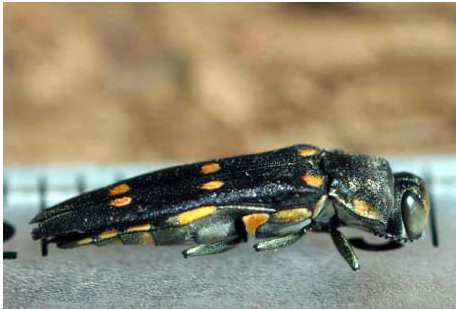
Adult goldspotted oak borer (Agrilus auroguttatus). Adults are approximately 0.35 inches long by 0.08 inches wide.