Yerba Mansa
By Linda Vasconcellos
(Editor’s Note: Linda is a retired nurse who now volunteers at the San Diego Natural History Museum in their NATuralist program. The NATuralists engage the public while in the museum through fun, interactive games and crafts.)
Yerba Mansa (Anemopsis californica) is an interesting plant in that it is a basal angiosperm; descendant of one of the oldest lineages that branched off before the rest of the angiosperms (what we think of as flowing plants) evolved. The basal angiosperms are only a few hundred species, compared with hundreds of thousands of eudicots, monocots, and magnoliids. Anemopsis californica is part of the lizard’s-tail plant family (Saururaceae) that comprises four genera and seven species and is in the order of Piperales; which includes the well-known plants black pepper, kava, birthwort, and wild ginger.
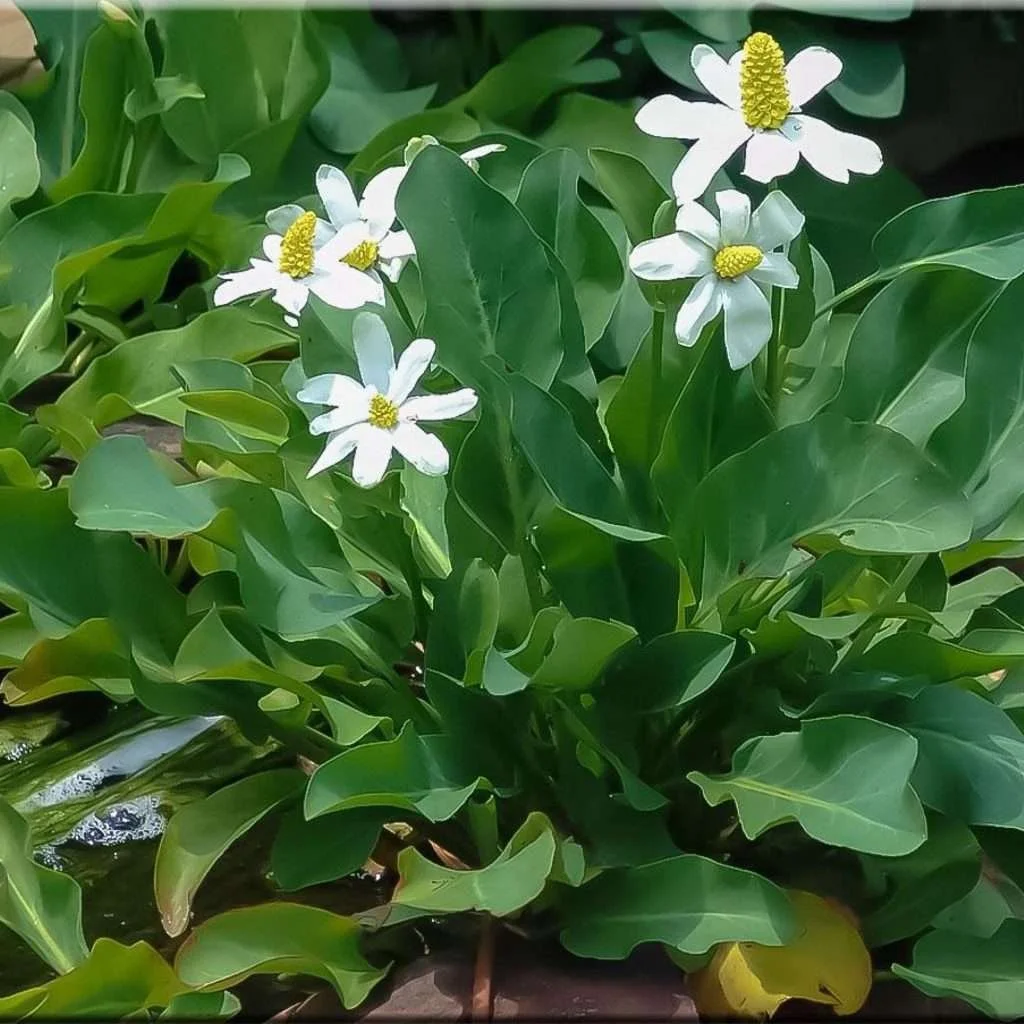
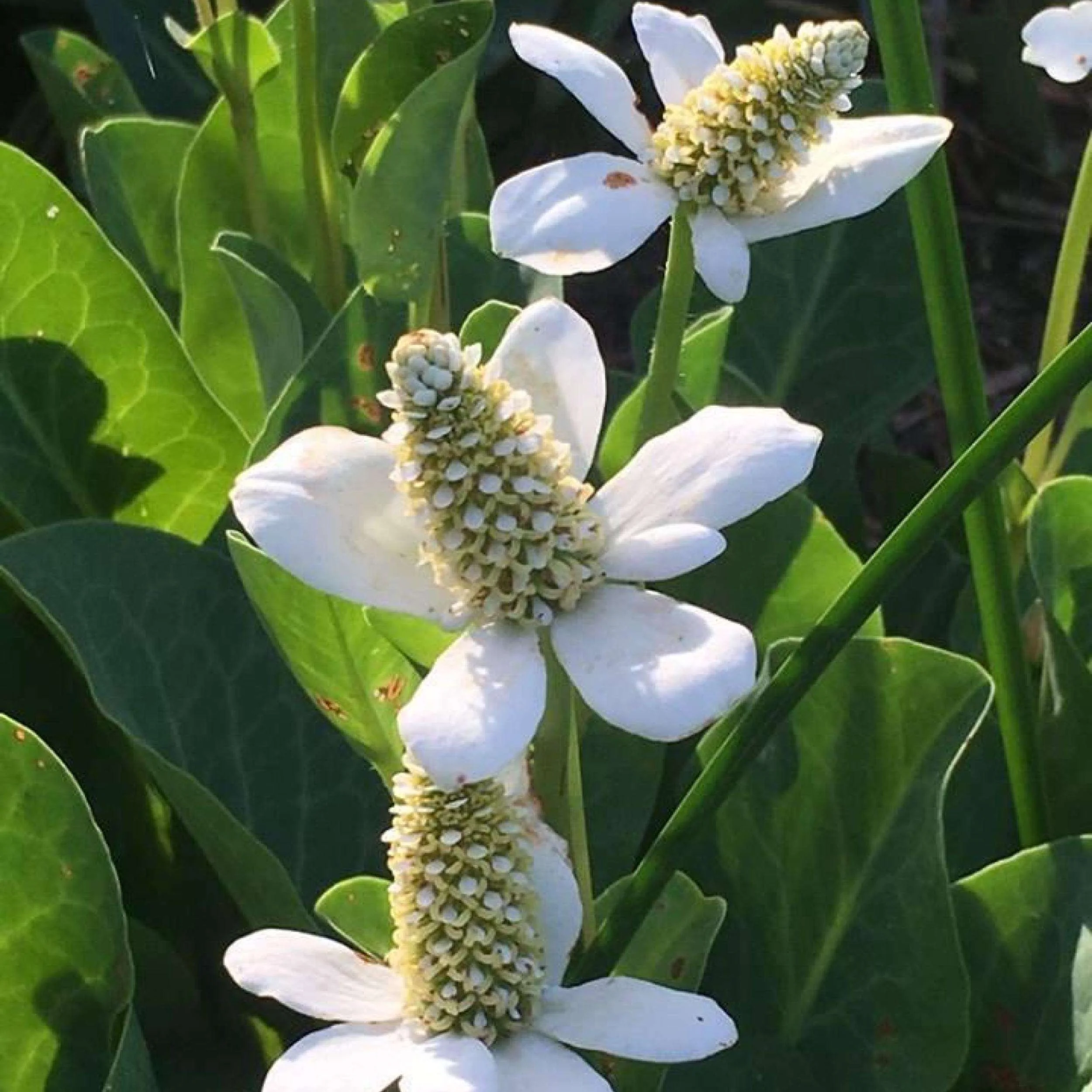
Yerba Mansa is a perennial fairly low growing herb that often forms large mats from horizontal stems (stolons and rhizomes) spreading out at or just above ground level. Clumps of leaves are produced and form roots at discrete nodes along these stems. Anemopsis californica is native to southwestern North America and can be found from Oregon to northern Mexico and Baja California. It prefers very wet soil and can be found along creek edges, seeps, springs, or low- lying wetland areas and can thrive in either alkaline or saline soil. It has beautiful, tiny, scented white flowers that rise above the foliage in a spike shape, providing easy access to bees and butterflies. These flowers are clustered into a cone inflorescence surrounded by 4-9 large white spoon-shaped petaloid bracts that look like petals at the base of each cone. The female parts are the three lobed cream-colored stigmas and the male parts are the yellowish-brown stamens. The conical structure itself develops into a single tough fruit that can be carried downstream to spread tiny pepper like seeds. The foliage consists of large, deep green leaves up to 6 inches long exuding a strong, spicy, musty, almost cinnamon scent. Yerba Mansa takes on red tints with cold and turns brick red in the fall. It will then die back and in the spring fresh new growth will appear.
Yerba Mansa has been called the midwife’s panacea as it has numerous medicinal uses including anti-inflammatory, antimicrobial, and anti-fungal properties. Interestingly the name Mansa, which in Spanish means calming, would lead you to think the herb has a sedative effect which would be incorrect. Some believe the current name was shortened from yerba del manso or “herb of the tame indian”. A third more logical explanation is that the word “manso” has been shortened from “remanso” which means “backwater” making the original name yerba remanso or “herb of the backwater”. The Kumeyaay’s name for Yerba Manso is “Ellykis” and the Chumash call it “Onchochi”.
Across the Southwest numerous nations have documented the traditional value that is universally held for this versatile plant and its many medicinal applications. Root, leaf, and flower all have antiseptic properties and can be administered as a tea, tincture, infusion, or soak. For wounds or infected sores, the Kumeyaay make a tea from the leaves or roots to wash the infected area. For internal wounds or bruising they could ingest an infusion. For a toothache, Yerba Mansa leaves can act like an anesthetic, deadening feeling in the mouth. To aid in digestive disorders or treating a cold, a tea made from pounded roots was said to be efficacious. For the Chumash peoples the herb serves an essential part of a ritual purification ceremony. Ethnobotanist Jan Timbrook’s research shows that Yerba Mansa has been intentionally spread by native peoples; establishing large patches where the plant could thrive and reproduce.
Scientific studies have definitively identified compounds in the herb such as flavonoids, phenylpropenes, and sesquiterpene lactones which would contribute to Yerba Mansa’s well known anti-inflammatory effects, antioxidant potential, and antimicrobial properties. In vitro studies have clearly demonstrated that Yerba Mansa extracts can inhibit the growth of various bacteria like Staphylococcus and Streptococcus pneumonia. Researchers also have determined the herb may indeed possess anti-inflammatory properties beneficial for conditions like arthritis and skin inflammation, as well as anti-oxidant properties that clear harmful free radicals from the body. More robust clinical trials would be helpful to document efficacy; but it is clear that science confirms why indigenous peoples have valued, nurtured, and made Anemopsis californica an essential part of their spiritual and healing culture. In addition to its beauty and unique history in plant evolution this legendary paleo-herb is a universally important medicinal plant of an elevated stature.
References:
1. Calflora https://www.calflora.org Anemopsis californica
2. Jepson Herbaria https://ucjeps.berkeley.edu Saururaceae
3. Meza Cuero, Jon (2011). Field Notes from interview by Michael Wilken. Tecate, Baja California, Mexico: Corridor Historico CAREM
4. Nature Collective https://naturecollective.org yerba mansa
5. Science Direct https://wwwsciencedirect.com (2008). Chemotypic variation of essential oils in the medicinal plant, Anemopsis californica
6. Timbrook, Jan (2007). Chumash Ethnobotany: Plant knowledge among the Chumash people of Southern California
7. Wilken-Roberston Michael (2018). Kumeyaay Ethnobotany: Shared Heritage of the Californias